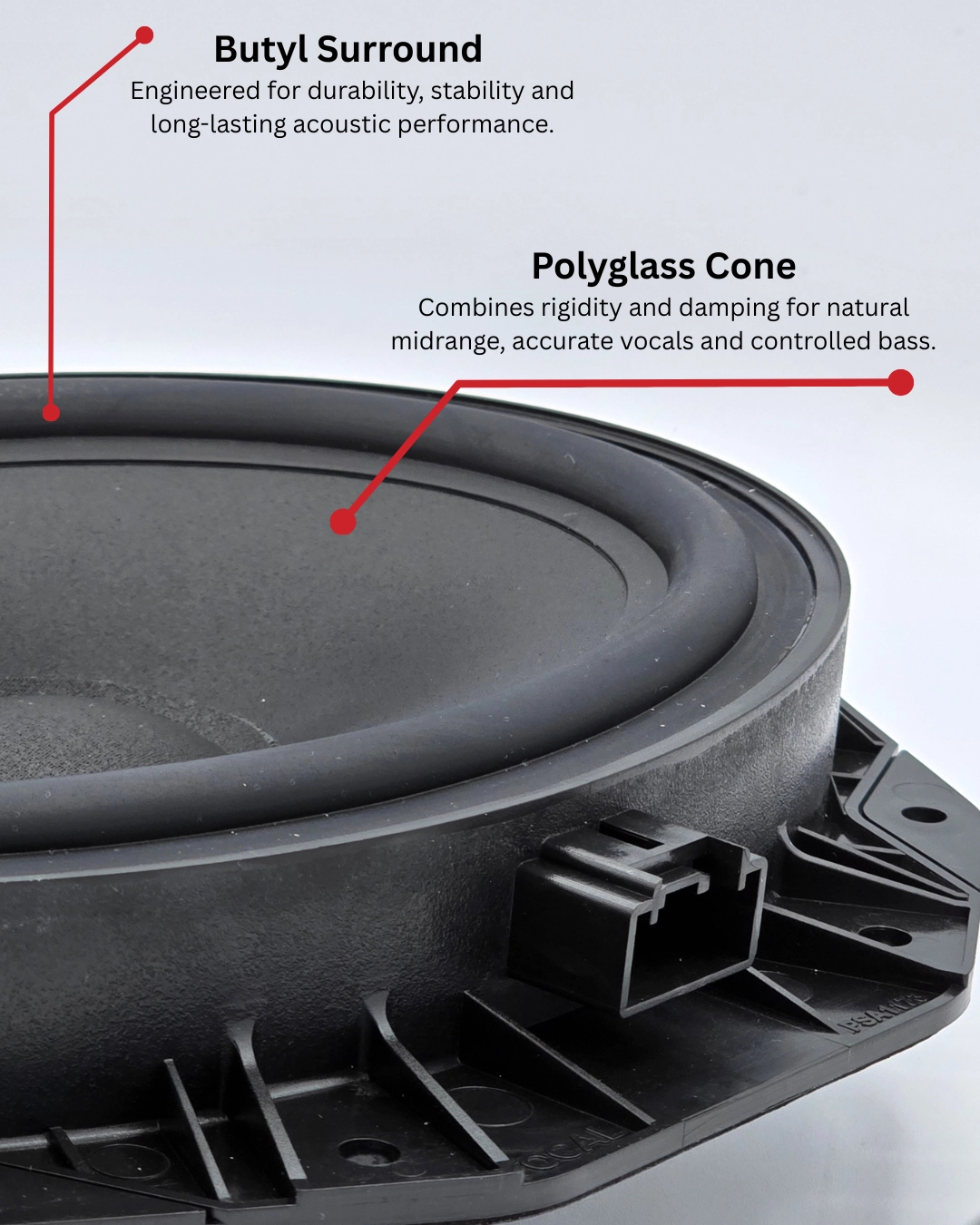
The Focal Polyglass cone and butyl surround are two important parts of many Focal car audio speakers, including selected Focal Inside and Polyglass-based loudspeaker designs. Together, they help the speaker reproduce music with better clarity, control, durability and long-term consistency than many basic factory speakers.
The cone is one of the most important parts of any loudspeaker. It is the moving surface that pushes air to create sound. When electrical energy from the amplifier reaches the speaker, the voice coil moves the cone forward and backward. The accuracy of that movement has a direct effect on how clearly vocals, instruments, bass notes and musical detail are reproduced.
Focal’s Polyglass cone technology combines a cellulose-pulp cone with fine glass microbeads applied to the surface. This approach is designed to bring together two important acoustic qualities: the natural damping characteristics of paper and the increased rigidity of glass. In simple terms, the cone needs to be light enough to move quickly, rigid enough to resist unwanted flexing, and controlled enough to avoid adding unwanted colouration to the music.
This balance is important because a speaker cone is constantly moving while music plays. If the cone flexes too much, the sound can become less accurate. Vocals may lose definition, instruments may blur together, and the overall presentation can become muddy or uncontrolled. A more stable cone helps the speaker follow the music signal more precisely.
In real-world listening, the benefit of Polyglass is often heard through improved midrange definition. The midrange is where much of the emotional content of music lives, including vocals, guitars, piano, brass, strings and many natural instrument tones. When this frequency range is reproduced clearly, music sounds more lifelike and easier to understand.
This is especially important in a vehicle, where the listening environment is far from ideal. Car speakers are often installed low in doors, behind factory grilles, near reflective glass and surrounded by road noise, trim panels and vibration. A speaker needs good mechanical control to deliver clarity in these conditions.
The butyl surround also plays an important role. The surround is the flexible outer suspension that connects the cone to the speaker frame. It allows the cone to move while helping control its travel. If the surround is too soft, too stiff or prone to deterioration, the speaker may lose accuracy, control or reliability over time.
Butyl is commonly used in quality speaker designs because it provides durability, flexibility and long-term stability. Inside a vehicle, this matters. Car speakers are exposed to heat, cold, humidity, vibration, dust and constant movement. A durable surround helps the speaker maintain consistent performance through years of everyday driving.
The cone and surround should not be viewed as separate materials working in isolation. They form part of the loudspeaker’s mechanical system, along with the voice coil, magnet, motor structure, spider and frame. Each part affects how accurately the speaker converts electrical energy into sound.
When the Polyglass cone and butyl surround work together, the aim is to improve control. Better control can help the speaker start and stop more accurately, reduce unwanted distortion and reproduce music with greater precision. This can make voices sound clearer, instruments easier to distinguish and bass or midbass notes more defined.
Compared with many factory speakers, this can be a significant upgrade. Factory speakers are often designed to meet vehicle manufacturing budgets, weight targets and packaging limits. They may perform adequately for basic listening, but they are not always built for high-fidelity sound reproduction. A Focal speaker using Polyglass cone technology and a quality butyl surround is designed with a stronger focus on acoustic performance.
This does not mean materials alone determine sound quality. Installation still matters. A good speaker can underperform if it is poorly mounted, incorrectly wired, not properly sealed to the door or used with unsuitable amplification. The speaker needs the right environment to deliver its intended performance.
Door sound deadening can also help. By reducing vibration and creating a more stable mounting surface, sound deadening can allow the speaker to reproduce midbass and midrange frequencies with more control. This is why many installers recommend sound deadening when fitting quality aftermarket speakers.
For Focal Inside applications, the benefit is that these materials can be combined with vehicle-specific fitment. The goal is not only to use better loudspeaker technology, but to apply that technology in a way that suits compatible factory speaker locations and vehicle integration requirements.
For drivers, the result can be clearer vocals, better instrument separation, more controlled midbass, smoother overall sound and a more enjoyable listening experience. Rather than simply making the system louder, the aim is to reveal more of the music that basic factory speakers may leave behind.
For the best result, speak with an Authorised Focal Australia Dealer. They can confirm which Focal speaker options are suitable for your vehicle, explain the benefits of Polyglass cone technology and butyl surround construction, and install the speakers correctly so they perform as intended.